Continuity through Change: Allotment Gardens and the Making of Living Heritage in Belgium and Leuven
Allotment and community gardens are receiving growing attention today, not only as places where food is grown, but also as spaces of encounter, leisure, knowledge exchange, and ecological engagement. At the same time, they are increasingly being framed as heritage. But what exactly makes an allotment garden heritage? Is it its history, the practices associated with it, its spatial organisation, or rather its capacity to adapt to changing needs and expectations over time? This project explores the history, present-day meanings, and heritage value of allotment gardens in Belgium, with a particular focus on Leuven.
The project starts from the observation that allotment gardens are often presented in public debate as vulnerable remnants of the past that need to be protected against urban pressure and redevelopment. This research proposes a different perspective. It asks whether the heritage value of allotment gardens lies not only in their age or continuity, but precisely in their long-term ability to adapt and take on new functions. Since the late nineteenth century, allotment gardens in Belgium have served many different purposes: they have been spaces of subsistence, social reform, moral education, political stabilisation, leisure, community building, and, more recently, ecological experimentation and urban agriculture. Rather than following a linear path, their history reveals a layered process in which older meanings continue to coexist with newer ones.
The project begins with a literature review. Drawing on existing historical and heritage scholarship, it examines how allotment gardens in Belgium and Flanders have emerged, developed, and been valued over time. This historical framework will provide the basis for understanding how allotment gardens are interpreted today.
The project will also investigate the specific context of allotment and community gardens in Leuven. To do so, surveys will be conducted among both organisers and users or gardeners involved in vegetable gardens. These surveys will explore the functions that allotment gardens fulfil today and the meanings that participants attach to them. In addition, the project will include in-depth interviews with around ten people involved in allotment gardening in different ways. These interviews will focus on their experiences, memories, and perceptions, but also explicitly on whether, and in what ways, they see allotment gardens as heritage.
In this way, the project aims to understand heritage not only as something defined by institutions, but also as something experienced, interpreted, and possibly claimed by people themselves. Are it the gardening practices and skills that are seen as heritage? The social relations and sense of community? The historical continuity of a site? Or does heritage play only a limited role in how gardeners understand these places today? By addressing these questions, the project contributes to wider reflections on heritage in urban environments and on the place of everyday, adaptive practices within heritage frameworks.
Ultimately, the project approaches allotment gardens as a form of living heritage: not as static survivals from the past, but as dynamic spaces where use, meaning, and memory come together. Precisely because allotment gardens continue to change over time, they offer a valuable lens through which to think about continuity and transformation, community formation in the city, and the ways people assign meaning to their everyday environment.
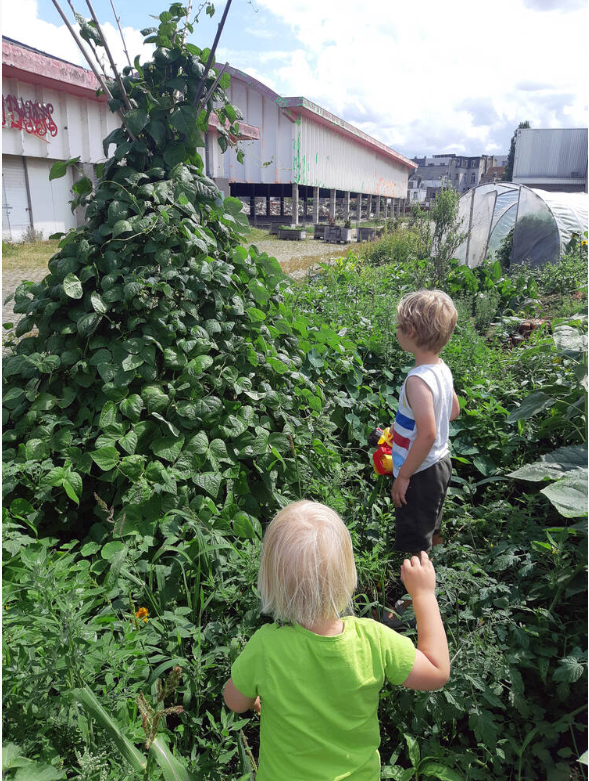 Children in a community garden in Antwerp, 2021. Private collection. © Bie Van Giel
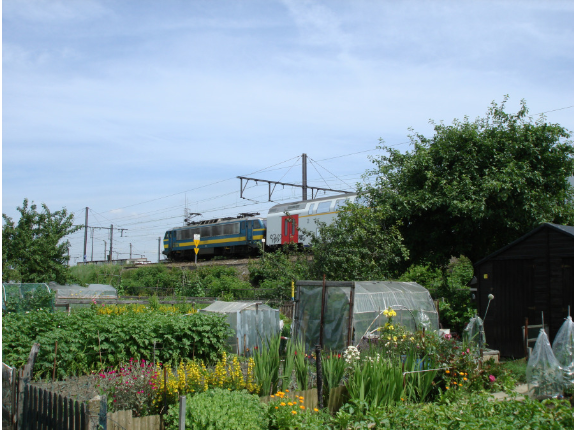 Community garden next to a railroad, 2007. CAG. ©Roeland Hermans