Granton Castle Walled Garden
Granton Castle walled garden dates to 1479. While the castle, long abandoned, was demolished in 1921, the gardens remained in commercial use until 2003, when Edinburgh City Council experimented with schemes for housing on the site. Since 2017 the garden has been maintained by an association of Friends.
Granton Castle, initially known as Granton House, was built for John Melville of Carnbee in 1479, on a ledge of rock overlooking Granton, (sometimes also called Royston) Beach, and adjacent to the Royston Burn, which still runs, although buried, through the site. Adjacent to the landing place of an English fleet In 1544 the castle was damaged in the first attack led by the Earl of Hertford in the “Rough Wooing of Scotland”, but was later restored.
In 1619 Sir Thomas Hope of Craighall acquired the property, making substantial alterations and documenting the garden in his diaries. By 1683, maps clearly depicted a defined garden boundary around the castle.
In 1740, John Campbell, 2nd Duke of Argyll, purchased the castle and the adjacent Royston House estate. He amalgamated the two properties to create an expansive estate named Caroline Park, in honour of his daughter. Granton Castle itself, its walled garden and doocot became ancillary structures associated to Caroline Park House, which is recognized as one of Scotland's most important surviving 17th-century houses. The development of the Caroline Park estate flourished between 1740 and the 1760s under the influence of the eponymous Lady Caroline Campbell. During this period, the old walled garden of Granton Castle was integrated into an elaborate planned landscape.
From the 1760s, Caroline Park House was leased out, and upon Lady Caroline's death in 1794, ownership transferred to the Buccleuch family. Granton Castle itself was also briefly leased until the late 18th century, after which it was abandoned and fell into ruin.
Despite its dilapidated state, memoirs from the early 19th century by Lord Henry Cockburn reveal that the castle was partially occupied by the estate gardener; and it was celebrated as a picturesque ruin in numerous 19th-century paintings, photographs, and postcards, suggesting its romantic appeal was valued by the owners of Caroline Park House. A late 19th-century account described the walled garden as "an enchanting tangle of flowers, fruit trees and shady bowers," highlighting its continued charm even as the surrounding parkland was diminishing.
The 19th century brought significant changes to the Caroline Park estate, largely driven by the industrial interests of the Buccleuch family. The parkland was gradually encroached upon by major developments, including the construction of Granton Harbour, a quarry, a railway line, and, most notably, the gasworks built to the west in 1897. While the wider landscape was being industrialized, the walled garden itself saw few alterations until the late 19th and early 20th centuries, when two long ranges of glasshouses were added. The most significant physical change was the demolition of Granton Castle in 1921, which had been undermined by quarrying activities. This left a permanent gap in the northeast section of the garden wall.
Following the destruction of the castle in 1921, the garden was owned by the Smith family and used as a market garden. The Smiths then left the garden to Edinburgh Council. In 2004, EDI/Waterfront Edinburgh Ltd. submitted applications to build luxury housing on site. In 2013, there was a local push to retain the garden for community use and by 2016 the housing proposals were withdrawn. In 2016, further proposals for residential development were rejected by Edinburgh Council.
The Friends of Granton Castle Walled Garden obtained access in 2017; and today, manage the site as a community garden. The site contains a Category B-listed perimeter wall with ornamental gateways (now blocked), a doocot (closed to the public, but stable), and dismantled Victorian and early 20th century greenhouses. The Garden provides unique environmental conditions for Scottish walled garden horticulture, containing a wide variety of uncommon plants. It is operated by volunteers who offer workshops in traditional gardening techniques and crafts, which demonstrates its ongoing use as a unique setting for heritage and learning. Excess produce is donated to charitable organisations in Granton and neighbouring Pilton.
Location: Granton, Edinburgh, Scotland (23 West Shore Road, EH5 1QB
Status: Doocot, boundary wall, and walled garden to Caroline Park (and to former Granton Castle), Excluding Glass Houses to North and Centre of Walled Garden are Listed Buildings (Category B) by Historic Environment Scotland (LB28139, added 14/12/1970)
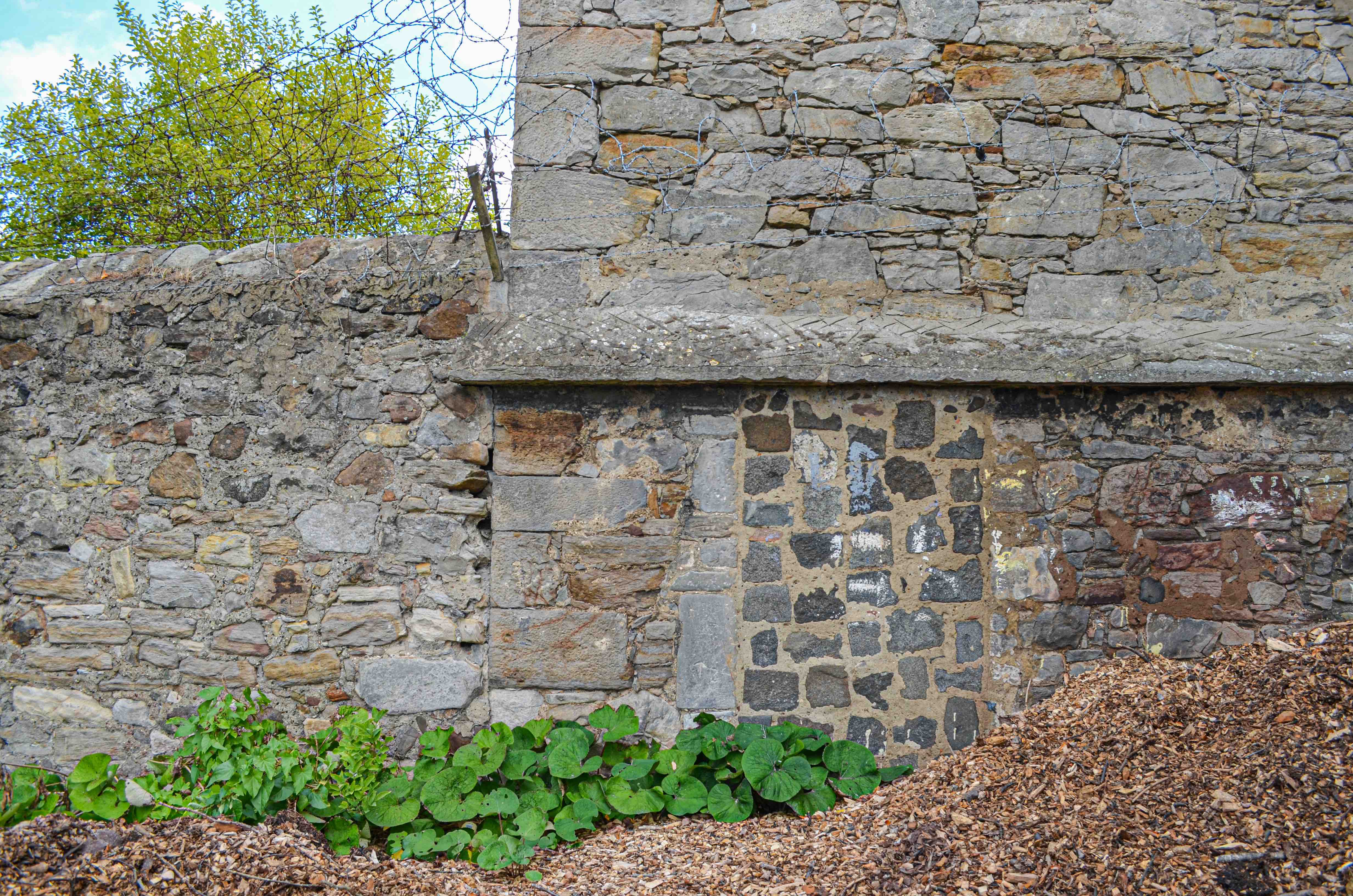 Granton Castle Walled Garden in Edinburgh. © Graham Skeate, 2025
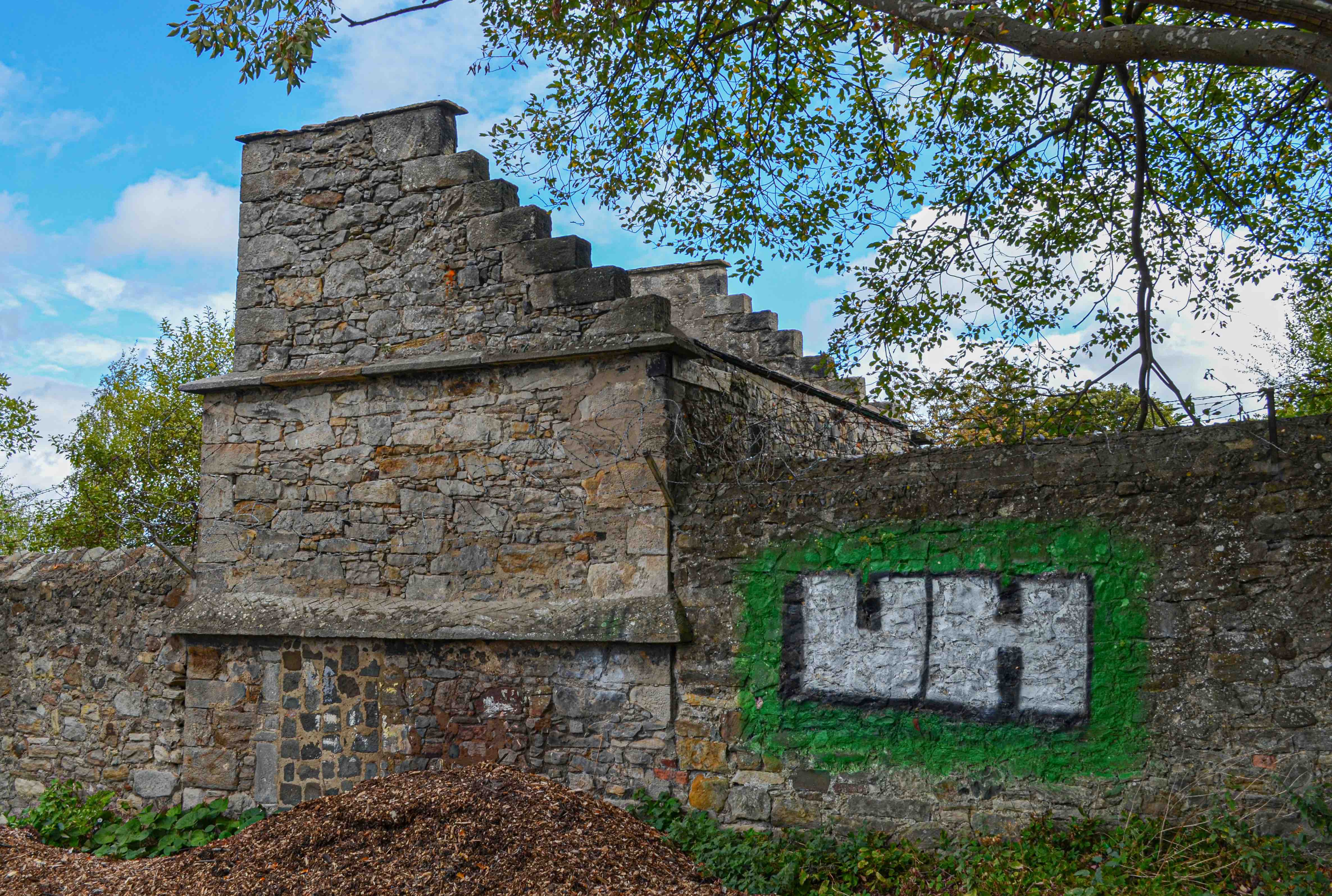 Granton Castle Walled Garden in Edinburgh. © Graham Skeate, 2025
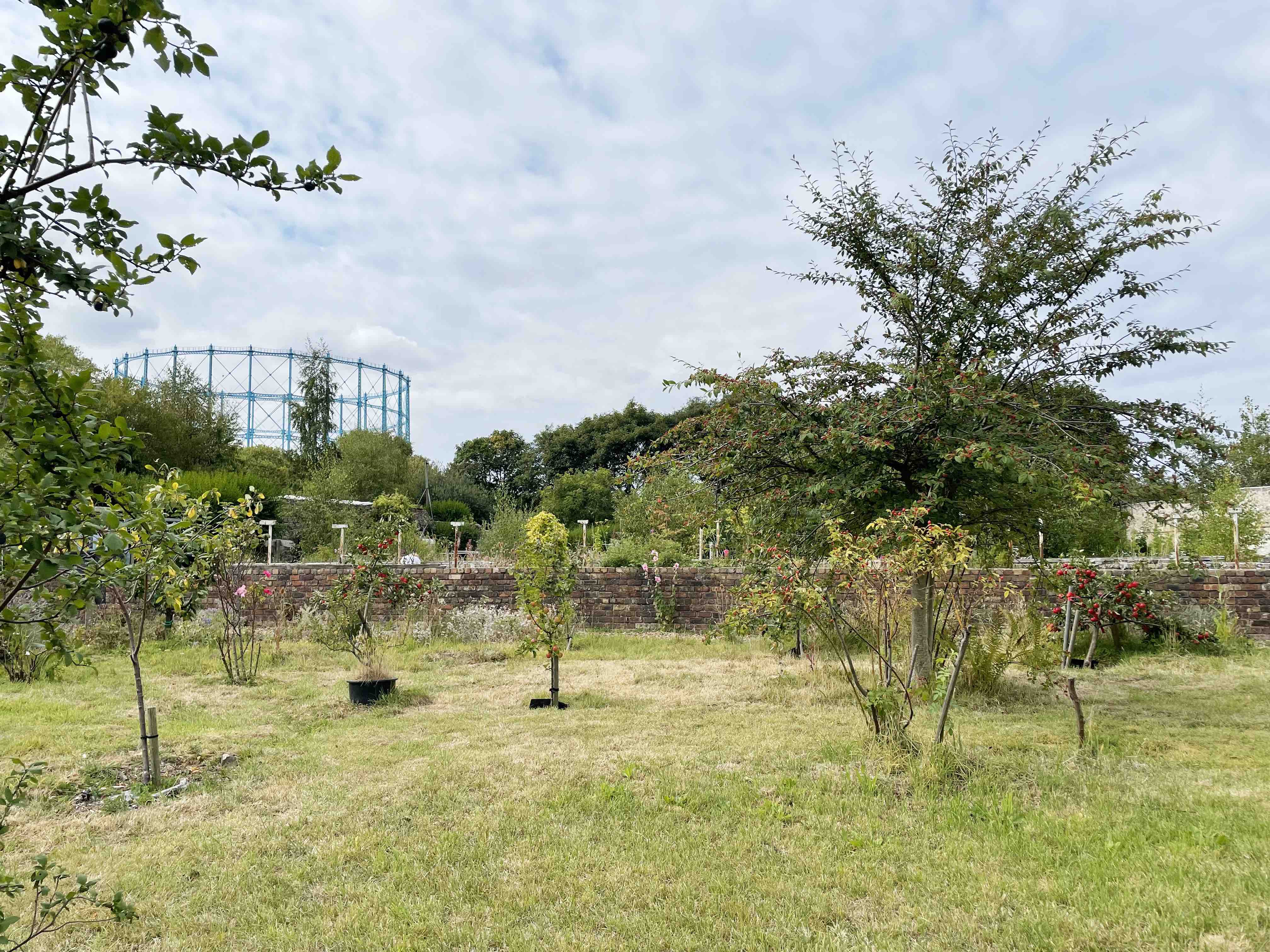 View of the garden. © Celia López-Bravo, 2025
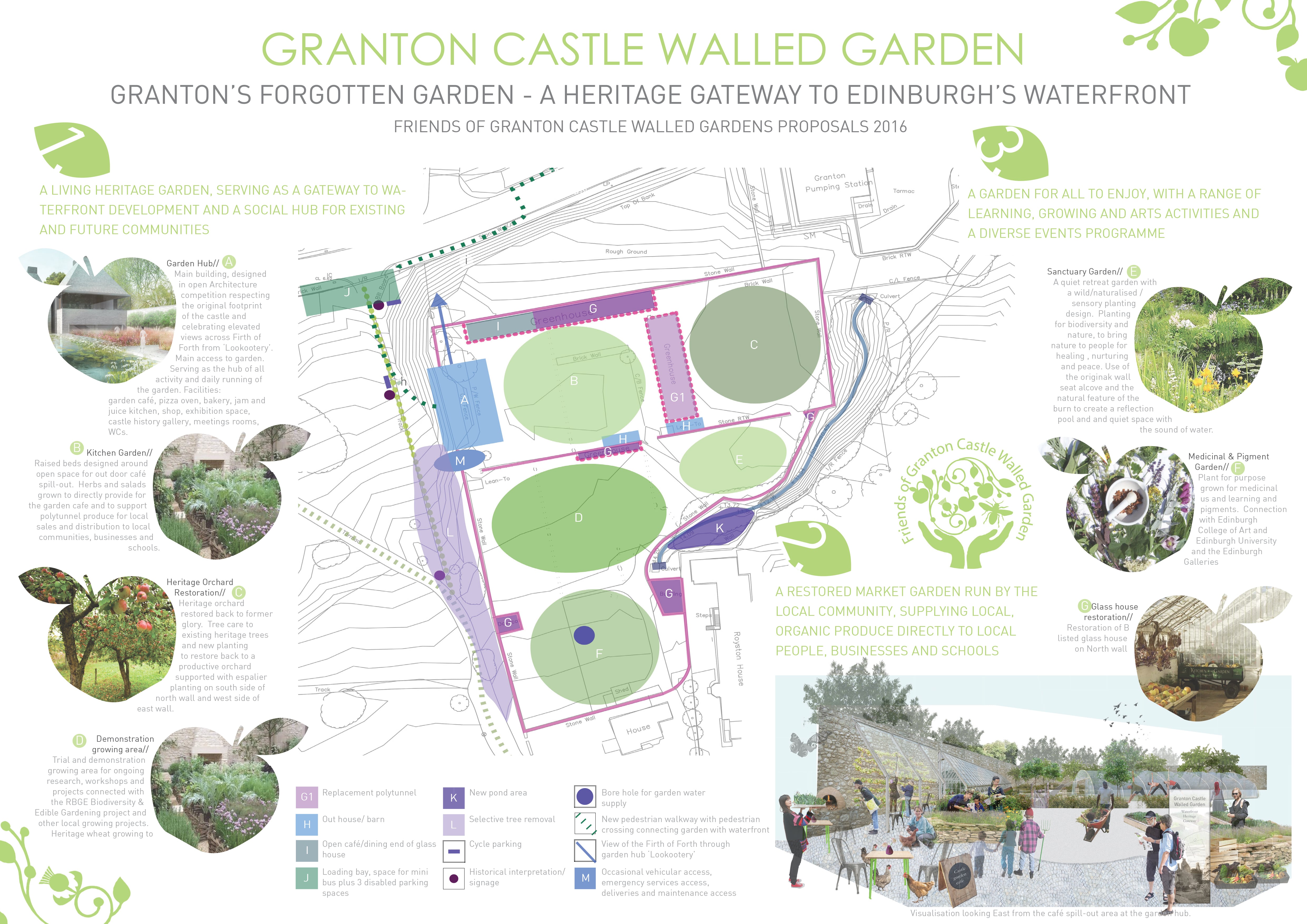 Garden proposal. © Friends of Granton Castle Walled Garden, 2016
Resources
CFA Archaeology (unpublished report, 2002) Granton Castle, Edinburgh: Archaeological Desk-based Assessment Report No. 759.
Currie C K (unpublished report, 2001) An archaeological desk-based assessment of Caroline Park, Granton, Edinburgh, Lothian, Scotland.
McVey D, Nash R and Stansbie P (2018) The motivations and experiences of community garden participants in Edinburgh, Scotland, Regional Studies, Regional Science, 5(1): 40-56 https://doi.org/10.1080/21681376.2017.1409650
Gifford J, McWilliam C, Walker D and Wilson C (1984) The Buildings of Scotland: Edinburgh, Penguin Books.
Harris D F (1896) Caroline Park House and Royston Castle: A Descriptive and Historical Account, Edinburgh.
Johnson M and Campbell K (2010) ‘Elements of an Eighteenth-Century Landscape Revealed: Excavations within the Former Gardens of Caroline Park House, Granton, Edinburgh’, Garden History, 38(1): 81–98 http://www.jstor.org/stable/27821618
Maxwell J (2023) A History and Guide to Scottish Castles, Pen and Sword History.
Royal Commission on Ancient and Historical Monuments of Scotland (1929) Inventory for Midlothian and West Lothian, pp. 30-32.
Web resources
Friends of Granton Castle Walled Garden (n.d.) Granton Castle Walled Garden, accessed 16 September 2025
Granton Castle Walled Garden (n.d.) Volunteering, accessed 30 September 2025.
Granton Castle Walled Garden (n.d.) Garden Map: Edinburgh’s ‘Lost’ Historic Garden, accessed 30 September 2025.
Granton History (n.d.) Granton Castle, accessed 16 September 2025
Historic Environment Scotland Portal (n.d.) Doocot, boundary wall, and walled garden to Caroline Park (and to former Granton Castle), Excluding Glass Houses to North and Centre of Walled Garden, Caroline Park and West Shore Road, Edinburgh 300017749, accessed 22 September 2025.
Weir, W (n.d.) Chronology of Granton House/Castle, accessed 16 September 2025
Archival images
View of remains, 1890, Historic Environment Scotland Archives https://www.trove.scot/image/1225546
View from south of Granton Castle and Dovecot, 1900-1930, Historic Environment Scotland Archives https://www.trove.scot/image/581335
View of castle from South West, 1900, Historic Environment Scotland Archives https://www.trove.scot/image/1124562